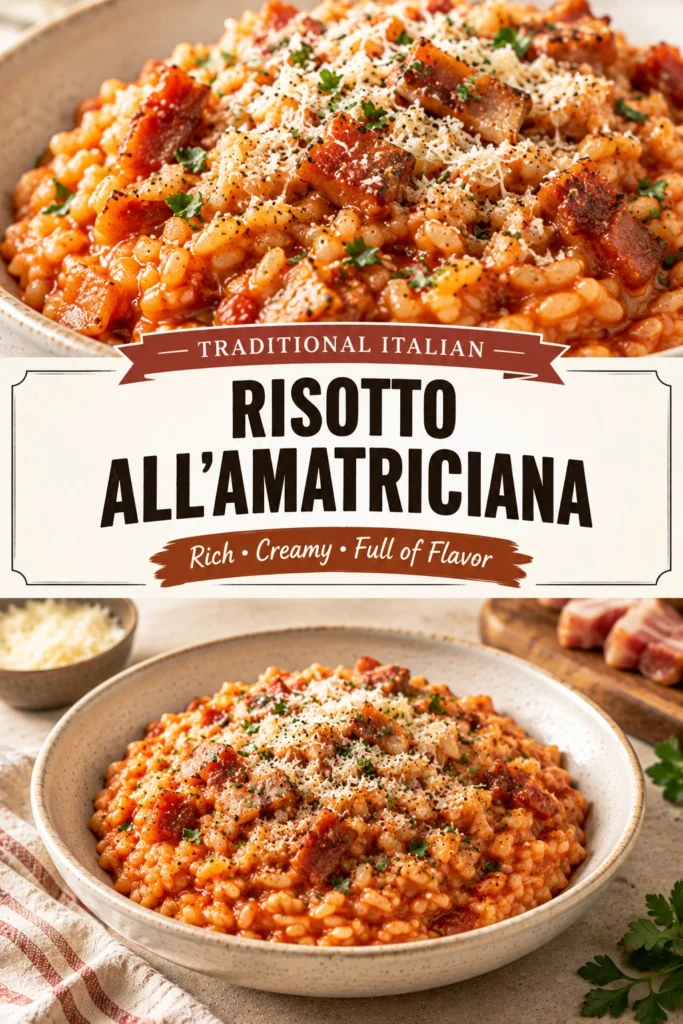
The moment the guanciale renders its fat into a golden, shimmering pool, the foundation for this dish is set. As the rice toasts in that salty pork oil, it absorbs a depth of flavor that transforms a standard porridge into a rich, savory meal.
Risotto All’Amatriciana is a hybrid of two Italian icons: the slow-stirred creaminess of northern risotto and the bold, spicy tomato-and-pork profile of a traditional Amatriciana sauce.
Many home cooks enjoy this version because it offers a more substantial texture than the pasta equivalent, making it feel like a complete meal in a single pot.
The uniqueness lies in the contrast between the sharp, salty Pecorino Romano cheese and the sweet acidity of the tomatoes, all bound together release of the rice.
While store-bought risotto mixes often rely on artificial thickeners, this version uses the natural starch from the grains to create a velvety emulsion.
It is a suitable choice for anyone who appreciates robust flavors and doesn’t mind spending twenty minutes at the stove for a high-quality result.
Preparation becomes simpler if you keep your broth simmering in a separate pot, which prevents the rice temperature from dropping during each addition.
- ●Why You’ll Love This Recipe
- ●A Brief Background / Why This Recipe Works
- ●Perfect For Slow-Paced Dinners and Impressing Guests
- ●Main Ingredient Spotlight: Arborio Rice
- ●Secondary Ingredient Spotlight: Guanciale
- ●Key Ingredients
- ●How to Make It
- ●Pro Tips
- ●Delicious Variations
- ●Best Ways to Serve
- ●Storage and Leftovers
- ●Frequently Asked Questions
- ●Why This Recipe Belongs in Your Weekly Rotation
- ●Final Thoughts
This dish balances intensity and comfort, providing a rich dining experience that feels elevated yet grounded in traditional flavors.
- ●The smoky depth from cured pork adds a layer of complexity that butter alone cannot provide.
- ●The creamy consistency provides a satisfying mouthfeel without needing heavy cream.
- ●Tomato acidity cuts through the richness of the cheese and pork fat.
- ●It utilizes a single pan for the majority of the cooking process.
- ●The bold seasoning stands up well to a variety of side dishes.
- ●It transforms pantry staples like rice and canned tomatoes into a gourmet meal.
- ●The slow cooking process allows the flavors to meld deeply into the grain.
- ●It offers a sophisticated alternative to standard tomato-based rice dishes.
Combining these elements results in a meal that is both hearty and refined.
A Brief Background / Why This Recipe Works |
The Amatriciana flavor profile originates from the town of Amatrice, traditionally relying on guanciale, tomato, and pecorino. Translating this to a risotto means replacing the pasta’s surface starch with the internal starch of the rice, which creates a more integrated sauce.
The success of the dish depends on the constant movement of the rice. Stirring rubs the grains together, shaking loose the amylopectin that thickens the broth into a cream. When the tomato puree is added, it binds to this starch, creating a glossy, orange-red finish.
Using a strong, salty cheese like Pecorino Romano is essential because it complements the cured pork rather than competing with it. The final addition of cold butter and cheese, known as mantecatura, stabilizes the emulsion for a smooth finish.
Perfect For Slow-Paced Dinners and Impressing Guests |
This recipe is well-suited for evenings where the process of cooking is part of the enjoyment. Because it requires attention and stirring, it serves as a relaxing activity for the cook while the aroma fills the kitchen.
For those hosting a small gathering, this risotto makes a striking centerpiece. It looks elegant on the plate and provides a flavor profile that is more complex than typical side dishes, making it a strong main course for a dinner party.
While it is less suited for a rushed Tuesday night, it is an excellent choice for Sunday dinners where family members can linger around the table. If you enjoy other creamy Italian dishes, you might also appreciate a Tasty Chicken Caesar Pasta Salad Recipe For All Occasions for a lighter contrast.
Main Ingredient Spotlight: Arborio Rice |
Arborio rice is the engine of this recipe. Its high starch content and short, plump grain allow it to absorb large amounts of liquid while maintaining a distinct center. If you use long-grain rice, the dish will be separate and dry rather than creamy.
The grain’s ability to withstand prolonged stirring without breaking down completely is what gives the risotto its characteristic chew. This structural integrity ensures that the rice carries the heavy Amatriciana sauce without turning into a mushy paste.
Secondary Ingredient Spotlight: Guanciale |
Guanciale, cured pork jowl, provides a funky, salty, and deeply porky flavor that defines the Amatriciana style. Its high fat content is crucial, as this fat is used to toast the rice and flavor the entire base of the dish.
Unlike bacon, which is smoked and cured from the belly, guanciale offers a cleaner, more intense pork taste. If replaced with pancetta, the dish remains salty, but it loses the specific richness associated with the jowl.
Key Ingredients |
Each component is chosen to build a balance of fat, acidity, and salt.
- ●Arborio Rice — Provides the essential starch for creaminess and a firm texture.
- ●Guanciale — Adds a salty, smoky depth and provides the cooking fat.
- ●Tomato Puree — Supplies acidity and the signature red color of the sauce.
- ●Chicken Broth — The liquid base that carries the flavor into the heart of the grain.
- ●Pecorino Romano — A sharp, salty sheep’s milk cheese that thickens the final emulsion.
- ●Onion — Adds a subtle sweetness to balance the salt of the pork.
- ●Red Chili Flakes — Introduces a gentle heat that cuts through the richness.
- ●Unsalted Butter — Used at the end to create a glossy, professional finish.
How to Make It |
The key is patience and temperature control to ensure the rice cooks evenly.
- Render the pork: Place diced guanciale in a wide pan over medium heat. Cook until the fat has melted and the pieces are crisp and golden. Remove the crisp pork with a slotted spoon, leaving the fat in the pan.
- Sauté the aromatics: Add finely diced onion to the pork fat. Cook until translucent but not browned, then stir in the red chili flakes. Burning the onion creates a bitter taste, so keep the heat moderate.
- Toast the rice: Pour in the Arborio rice. Stir constantly for two minutes until the edges of the grains become translucent but the center remains white. This toasts the exterior and prevents the rice from overcooking too quickly.
- Introduce the tomato: Stir in the tomato puree. Let it cook for a few minutes until it darkens slightly and becomes fragrant. This concentrates the tomato flavor before the liquid is added.
- Simmer with broth: Add one ladle of hot chicken broth. Stir frequently until the liquid is almost entirely absorbed. Continue adding broth one ladle at a time, waiting for absorption before adding more. This slow release of starch is what creates the creaminess.
- Check for doneness: After about 18 to 20 minutes, taste the rice. It should be tender but have a slight bite in the center (al dente). If it is too firm, add one more ladle of broth.
- Perform the mantecatura: Remove the pan from the heat. Vigorously stir in cold butter and grated Pecorino Romano. This final step emulsifies the fats and starches into a velvety sauce.
- Final assembly: Fold the crisped guanciale back into the rice and serve immediately on warm plates.
1Small adjustments in technique can significantly alter the final texture.
- ●2Keep broth hot: Use a small pot to keep your broth at a simmer. Adding cold broth shocks the rice and slows the cooking process.
- ●3Use a wide pan: A wide skillet allows for even evaporation and ensures the rice cooks in a consistent layer.
- ●4Do not rinse the rice: Rinsing removes the surface starch, which is exactly what you need to create the creamy consistency.
- ●5Stir but don’t obsess: While stirring is necessary, you do not need to move the spoon every second. Frequent movement is enough to release the starch.
- ●6Use cold butter: Adding chilled butter at the end creates a more stable emulsion and a glossier appearance.
Delicious Variations |
While the traditional flavors are strong, these adjustments can tailor the dish to different preferences.
- ●Vegetarian Swap: Replace guanciale with smoked sun-dried tomatoes and use a vegan butter and nutritional yeast instead of Pecorino.
- ●Spicier Kick: Use a combination of red chili flakes and a teaspoon of Calabrian chili paste for a more complex, fermented heat.
- ●Seasonal Green: Stir in a handful of fresh ba frozen peas during the last two minutes of cooking for color and nutrition.
- ●Mushroom Blend: Sauté sliced cremini mushrooms with the onions to add an earthy, umami undertone to the tomato sauce.
- ●Creamier Finish: Stir in a tablespoon of mascarpone cheese along with the butter for an even more luxurious texture.
These changes allow the recipe to adapt to different dietary needs without losing the core identity of the dish.
Best Ways to Serve |
Presentation and accompaniment can elevate the experience of a rich risotto.
- ●Serve in shallow bowls to keep the heat centered.
- ●Top with a final sprinkle of Pecorino Romano and a pinch of fresh black pepper.
- ●Pair with a crisp arugula salad dressed in lemon and olive oil to cut through the richness.
- ●Accompany with toasted ciabatta rubbed with a garlic clove.
Because the risotto is quite heavy, light and acidic sides work best. A glass of dry white wine or a light red like Chianti complements the pork and tomato notes.
Avoid serving it with other heavy starches like mashed potatoes, as the rice is already very filling. Instead, focus on fresh, bitter greens that cleanse the palate between bites.
Storage and Leftovers |
Refrigerating
Store leftovers in an airtight container in the fridge for up to 3 days. The risotto will thicken significantly as it cools because the rice continues to absorb liquid.
Reheating
Place the risotto in a pan over medium heat. Add a splash of broth, water, or white wine to loosen the starch. Stir gently until creamy and heated through, roughly 5 to 7 minutes.
Freezing
Risotto does not freeze well because the emulsion breaks and the texture becomes grainy. It is best consumed within the refrigerated window or avoided in the freezer entirely.
Frequently Asked Questions |
- ●Q: Can I use a different type of rice?A: While Carnaroli rice is an excellent substitute because it has even more starch than Arborio, long-grain or basmati rice will not work. Those varieties lack the amylopectin needed to create the creamy sauce, resulting in a separate grain rather than a cohesive risotto.
- ●Q: What if I cannot find guanciale?A: Pancetta is the closest alternative as it is also a cured pork product. While it lacks the specific funkiness of the pork jowl, it provides the necessary salt and fat. Avoid using standard breakfast bacon if possible, as the smoky flavor can overpower the tomato.
- ●Q: How do I know when the rice is al dente?A: Take a single grain and press it between your fingers or bite into it. You should feel a tiny, firm core in the center of the grain. If the center is mushy, it is overcooked; if it feels like a raw seed, it needs more broth.
- ●Q: Can I add the broth all at once?A: No, adding broth all at once turns the dish into a boiled rice porridge. The gradual addition and stirring process is what rubs the starch off the grains, which is the only way to achieve the characteristic velvety texture of a true risotto.
- ●Q: Is Pecorino Romano interchangeable with Parmesan?A: Parmesan is a softer, nuttier cheese, whereas Pecorino is sheep’s milk and much saltier. While Parmesan works, Pecorino is traditional for Amatriciana because its sharpness stands up better to the strong taste of guanciale and the acidity of the tomatoes.
Why This Recipe Belongs in Your Weekly Rotation |
Integrating this dish into your routine introduces a level of gourmet cooking that is surprisingly accessible. It teaches the fundamental technique of starch emulsion, which can be applied to many other risotto variations throughout the year.
The combination of cured pork and tomato is a timeless pairing that satisfies cravings for something salty and comforting. Because it is a one-pot meal, the cleanup is manageable despite the depth of flavor achieved.
Whether you are cooking for yourself or for guests, this recipe provides a reliable way to bring a taste of Italy into the home. It is a hearty, soul-warming meal that feels special every time it is served.
Final Thoughts |
Risotto All’Amatriciana is a masterful blend of creamy texture and bold, rustic flavors. slow-cooked nature of risotto with the sharp notes of guanciale and pecorino, it creates a dish that is both sophisticated and satisfying.
Making this recipe allows you to slow down and enjoy the process of cooking. The result is a rich, velvety meal that proves a few high-quality ingredients and a bit of patience can produce a professional result.
Grab your widest pan and let the aroma of rendering pork and simmering tomatoes fill your kitchen tonight.
Creamy Risotto All’Amatriciana
- Total Time: 40 minutes
- Yield: 4 servings 1x
Description
A luxurious fusion of creamy northern Italian risotto and the bold, smoky flavors of Amatriciana sauce from Amatrice. Featuring guanciale and Pecorino Romano.
Ingredients
- 1.5 cups Arborio rice
- 4 oz guanciale, diced
- 1 cup tomato puree
- 5 cups chicken broth, kept warm
- 1/2 cup Pecorino Romano, freshly grated
- 1 small onion, finely diced
- 1/2 tsp red chili flakes
- 2 tbsp unsalted butter, cold
- Salt and black pepper to taste
Instructions
- Heat a wide pan over medium heat and add the diced guanciale. Cook until the fat is rendered and the pork is golden and crisp. Remove the pork with a slotted spoon and set aside.
- In the remaining pork fat, sauté the finely diced onion until translucent. Stir in the red chili flakes and cook for 30 seconds.
- Add the Arborio rice to the pan. Stir constantly for 2 minutes until the edges of the grains are translucent.
- Stir in the tomato puree and cook for 3 minutes, allowing the tomato to concentrate and darken slightly.
- Add one ladle of warm chicken broth. Stir frequently until the liquid is absorbed.
- Continue adding broth one ladle at a time, stirring often, until the rice is tender but still has a slight bite (al dente). This usually takes 18-20 minutes.
- Remove the pan from heat. Vigorously stir in the cold butter and grated Pecorino Romano until a creamy emulsion forms.
- Fold the crisped guanciale back into the risotto. Season with black pepper and serve immediately.
- Prep Time: 10 minutes
- Cook Time: 30 minutes
- Category: Dinner
- Method: Stovetop
- Cuisine: Italian